
Herceptin

Herceptin and HER2-positive breast cancer

Herceptin is a targeted therapy for HER2-positive breast cancer.

HER2 stands for human epidermal growth factor 2, a protein located on the surfaces of cells involved in controlling cell proliferation. Breast cancer tumours that have higher-than-normal levels of HER2 are said to be ‘over-expressing’ this protein, and are referred to as HER2 positive. About 23% of breast cancers are HER2 positive.

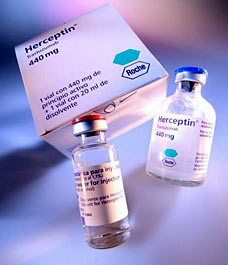
Herceptin (generic name: trastuzumab) is a drug designed to lock onto and shut down the HER2 protein. Its molecular structure is based on an antibody that can precisely target the HER2 protein. Herceptin is a ‘biological drug’; it is manufactured using laboratory-cultured cells.

First approved in 1998, Herceptin has revolutionized the treatment of HER2 positive breast cancer.

Currently the standard treatment for early HER2 positive breast cancer is a course of chemotherapy followed by 12 months of Herceptin (given intravenously every 3 weeks). Long-term clinical trials have shown that receiving Herceptin after chemotherapy results in a 37% relative improvement in overall survival compared to receiving chemotherapy only. In other words, ten years after diagnosis 84% of those given Herceptin for their early-stage HER2 positive breast cancer were alive compared to only 75.2% of those who did not receive Herceptin [1]. 

Alternative brands of Herceptin, known as trastuzumab biosimilars, are now available overseas. Click here to learn more about these.

Duration of Herceptin treatment

Herceptin is an expensive drug compared to most chemotherapy drugs, partly because it has to be manufactured in a cell-culture system, rather than via a relatively straightforward chemical process. All the initial trials with Herceptin featured a 12-month course of treatment, and the evidence for its effectiveness and safety is based on this.

A number of subsequent clinical trials have looked at whether the same benefits could be derived from a treatment of shorter duration. These trials were designed as ‘non-inferiority trials’, meaning they are designed to show if a shorter (and therefore cheaper) course of Herceptin is ‘not worse’ in terms of cancer recurrence and survival than the 12-month regimen. Two similar trials, a French study called PHARE and a British one called PERSEPHONE, compared 6 months with 12 months of Herceptin. Both studies produced similar results, but each came to a different conclusion. The French study concluded that 6 months was not non-inferior (i.e. not the same and probably inferior) to 12 months. The UK study concluded that 6 months was non-inferior to 12 months and that a shorter treatment would be just as good as the standard 12-month course. The key difference was in how much inferiority each study would tolerate and still conclude equivalence between the two treatment durations. This is called the pre-specified non-inferiority margin.

In the French study, this was such that the six-month treatment could result in 1.5% more recurrences and still be called ‘non-inferior’ to the 12-month regimen. However, the UK study tolerated 3% more recurrences and so concluded equivalence, even though up to 3% of patients might have a worse outcome if they received only 6 months Herceptin instead of the standard treatment of 12 months. Deciding what is a reasonable non-inferiority margin, when the subject of the study is an aggressive form of cancer, remains a matter of debate [2]. Most clinicians have interpreted these results to mean that a 12-month course of Herceptin is still the standard, but if there is a medical reason why a patient cannot tolerate this then a shorter course may be a suitable trade-off option.

Sub-cutaneous Herceptin

Herceptin comes in two formulations – one for intravenous (IV) administration and one that can be administered sub-cutaneously (Herceptin SC or ‘sub-cut’) via an injection into the thigh. Both forms are to be given once every three weeks, but the sub-cut injection takes only 2 to 5 minutes, whereas IV infusion takes 90 minutes and has to be carried out in a hospital or private cancer clinic. Use of the sub-cut version could save both time and effort for patients, and time and resources for healthcare providers. Both are registered by Medsafe NZ, but only the IV formulation is publicly funded. Pharmaceutical company Roche applied to PHARMAC for funding for sub-cut Herceptin in 2014, but PHARMAC’s clinical advice committee recommended that it be funded only if the price could match that of the IV product. PHARMAC considers only the price of the medicine and not the cost savings that could be achieved elsewhere in the health system if patients did not need to attend hospital to receive a treatment. As at August 2020, sub-cut Herceptin remains on PHARMAC’s ‘waiting list’.

Herceptin and Perjeta

Perjeta® (generic name: pertuzumab) is another biological drug which targets a different site from Herceptin on the HER2 molecule. Both can be used together to treat HER2-positive breast cancer.

In New Zealand, Perjeta is Medsafe registered for use with Herceptin in treating early HER2-positive breast cancer before surgery (neoadjuvant) or after surgery (adjuvant) or treating advanced (metastatic) HER2-positive breast cancer.  As of August 2020, PHARMAC funds Perjeta only for use in metastatic patients. Early breast cancer patients can be treated with Perjeta only if they are prepared to pay for it in private practice.

Overseas, Perjeta combined with Herceptin is now considered a standard option for those with Stage II or III early HER2-positive breast cancer who are considered to be at high risk of recurrence (e.g. node-positive and/or tumour greater than 2 cm) [3, 4, 5].  Neoadjuvant (before surgery) treatment with Perjeta, Herceptin and docetaxel (chemotherapy) has been shown to significantly improve rates of pathologic complete response (the tumour shrinks away completely), compared to other treatments. Adjuvant (after surgery) treatment with Perjeta, Herceptin and chemotherapy has been shown to significantly improve disease-free survival in patients with node-positive HER2 positive breast cancer (3-year invasive disease-free survival rate of 92% compared to 90.2% without the addition of Perjeta) [3].

In June 2020, a sub-cutaneous formulation of Perjeta combined with Herceptin called Phesgo® was approved by the United States Food and Drug Administration (FDA).  This should offer greater convenience for patients and clinicians. It is not yet available in New Zealand.

20 August 2020

References

[1] Perez et al. Trastuzumab Plus Adjuvant Chemotherapy for Human Epidermal Growth Factor Receptor 2–Positive Breast Cancer: Planned Joint Analysis of Overall Survival from NSABP B-31 and NCCTG N9831. Journal of Clinical Oncology 32: no. 33 (Nov 20, 2014) 3744-3752.  https://ascopubs.org/doi/10.1200/JCO.2014.55.5730

[2] Hurvitz. Is the duration of adjuvant trastuzumab debate still clinically relevant?  Lancet 393: Issue 10191 (June 29, 2019) 2565-2567 https://www.thelancet.com/journals/lancet/article/PIIS0140-6736(19)30946-8/fulltext

[3] Goodman. Management of HER2-Positive Breast Cancer: Business as Usual? The ASCO Post (Dec 10, 2018) https://ascopost.com/issues/december-10-2018/management-of-her2-positive-breast-cancer/#:~:text=%E2%80%9CFor%20most%20patients%20with%20stage,has%20become%20a%20standard%20option.

[4] Cardoso et al. Early Breast Cancer: ESMO Clinical Practice Guidelines. Annals of Oncology (2019) 30: 1194-1220. https://www.esmo.org/content/download/284512/5623447/1/Clinical-Practice-Guidelines-Slideset-Early-Breast-Cancer.pdf

[5] SABCS 2019: After 6 Years, Adding Pertuzumab to Trastuzumab + Chemotherapy Continues to Yield Clinical Benefit in Operable HER2+ Early Breast Cancer. https://www.practiceupdate.com/content/sabcs-2019-after-6-years-adding-pertuzumab-to-trastuzumab-chemotherapy-continues-to-yield-clinical-benefit-in-operable-her2-early-breast-cancer/93731

 

HER2-positive breast cancer

About 16% of the 3400 New Zealanders diagnosed with breast cancer each year will have HER2-positive breast cancer.

HER2 stands for 'human epidermal growth factor receptor-type 2'. It is a type of protein that sits on the surface of all normal cells and its job is to send messages to the cell, telling it to grow and replicate.

If you have HER2-positive breast cancer, your cancer cells have an abnormally large number of HER2 proteins on their surface. This means the tumour has the potential to grow and spread at a fast rate. HER2-positive breast cancer tends to be more aggressive than some of the other sub-types.

Fortunately, the HER2 protein can be specifically targeted by some very effective anti-cancer drugs. 

Trastuzumab (brand names Herceptin®, Herzuma® and others) is the best known of these and is particularly effective for women with HER2-positive breast cancer. Trastuzumab is a manufactured antibody that binds to the HER2 protein, and blocks the signals that would otherwise cause the cancer to grow. It is designed to specifically target and treat cancers that are HER2 positive.

The role of HER2 in cancer was discovered in 1989 [1] and trastuzumab was developed by 1995. It was first trialled in women with metastatic HER2-positive breast cancer. Trastuzumab (original brand name Herceptin®) significantly improved survival in these patients, and these results led to its approval for this use in 1998. Trials were then carried out to see if trastuzumab could also be used to treat early HER2-positive breast cancer. By 2005, the researchers were able to report that a 12-month treatment with trastuzumab after surgery and chemotherapy could significantly reduce recurrence and improve survival in these patients as well.  Extended follow-up of over 4,000 patients confirmed these findings in 2012 [2]. A 12-month treatment programme of trastuzumab has been available in New Zealand for women with HER2-positive breast cancer since 2008. 

Trastuzumab is given as an intravenous infusion, usually once every three weeks, for 12 months.

The side effects of trastuzumab are generally mild, with the most common being flu-like symptoms, which usually occur shortly after the drug is given. More serious events, such as allergic reactions and breathing problems occur rarely.

Significant heart problems develop in a few women. Heart failure has occurred in 0.6 per cent of patients when trastuzumab is given following chemotherapy, and up to 4 per cent when given at the same time as taxane-based chemotherapy. In some cases specific drug treatment was required but in most patients, heart function recovered after stopping trastuzumab. The risk of heart failure is greater in women with previous heart problems. Patients must be checked for heart problems before receiving trastuzumab and must have their heart function monitored during treatment.

Several clinical trials have looked at whether trastuzumab could be given over a shorter period than 12 months and still give the same benefits. Recent analyses of the results have concluded that one year of treatment leads to better outcomes than shorter treatments [3,4].

12 months of trastuzumab is still the standard of care (March 2025), and shorter durations of treatment might only be considered where patients cannot tolerate side effects or have heart conditions that make any risk of cardiac toxicity unacceptable.

Herceptin® is the original patented version of trastuzumab, but now that its patents have expired, other companies are manufacturing biosimilar copies of this drug. (For more about trastuzumab biosimilars click here.)

In New Zealand, Herzuma® is the brand of trastuzumab that is currently publicly funded. You can read Medsafe’s consumer information leaflet on Herzuma® here.

Pertuzumab (brand name Perjeta®) is another drug that targets the HER2 protein, but binds to it at a different site from trastuzumab.

In New Zealand, pertuzumab is funded only for women with metastatic HER2-positive breast cancer, to be used in conjunction with trastuzumab.

However, recent research [5, 6] has also shown that pertuzumab can also be useful in treating early HER2-positive breast cancer, especially in cases where the features of the cancer at the time of diagnosis (such as stage, tumour size, nodal involvement) suggest a higher risk of the cancer returning after treatment (recurrence). Pertuzumab can be combined with trastuzumab and chemotherapy in these cases, but the patient will have to pay for pertuzumab and receive it in a private oncology clinic.  

Some patients with early HER2-positive breast cancer may benefit from treatment with pertuzumab and trastuzumab before their surgery. This is called neo-adjuvant therapy, which aims to shrink the tumour before surgery. Sometimes tumours treated in this way can become undetectable (called a pathological complete response). This use of pertuzumab is not yet funded in New Zealand but can be paid for privately.

You can read Medsafe’s consumer leaflet on Perjeta® here.

There is currently an application with PHARMAC asking for funding for Perjeta for early breast cancer but as yet no final decision has been made (March 2025).

Trastuzumab emtansine (also known as T-DM1; brand name Kadcyla®) is another anti-HER2 drug. It differs from trastuzumab and pertuzumab in that it is a two-part molecule that uses a trastuzumab molecule to carry a toxin (emtansine, also known as DM1) directly to the cancer cells that have lots of HER2 on their surfaces. There it locks on to the cell and only then releases the ‘payload’ toxin to kill that cell, with minimum collateral damage to other cells. Trastuzumab emtansine (Kadcyla®) is funded in New Zealand for women who have been diagnosed with metastatic HER2-positive breast cancer, have been treated with trastuzumab and perhaps also pertuzumab, but have had their cancer progress. 

Recent research has also demonstrated a role for trastuzumab emtansine in the treatment of early HER2-positive breast cancer. In patients at high risk of recurrence, whose tumours did not shrink completely after neoadjuvant treatment with trastuzumab and pertuzumab, adding trastuzumab emtansine to trastuzumab for their treatment after surgery reduced their risk of having a recurrence of invasive breast cancer or death by 50% [7]. Pharmac has now funded trastuzumab emtansine (Kadcyla®) for patients with early HER2-positive breast cancer who are at high risk of recurrence (2022). 

You can read the Medsafe consumer information leaflet on Kadcyla® here

Trastuzumab deruxtecan (also known as T-DXd; brand name Enhertu®) is another two-part anti-HER2 drug, with trastuzumab guiding the attached toxin (deruxtecan) to the HER2 molecules on the surfaces of the cancer cells. In New Zealand, trastuzumab deruxtecan is funded for those with metastatic HER2 positive breast cancer, whose cancer has stopped responding to other anti-HER2 therapy. 

You can read the Medsafe consumer information leaflet on Enhertu® here

Enhertu® has also been found to be useful in treating some other types of breast cancer called ‘HER2-low’ [8] or ‘HER2-ultralow’ [9], but it is not funded for those indications in New Zealand. Pharmac received an application for its use in treating unresectable (the tumour cannot be removed by surgery) or metastatic HER2-low breast cancer in April 2024, but no decision has been made on this yet (March 2025).

Find out more

The pharmaceutical company, Roche, has a website with some useful information about HER2-positive breast cancer, Herceptin®, Perjeta® and Kadcyla®.  Visit https://cancertreatments.co.nz/breast-cancer/

References

[1] Slamon et al. Studies of the HER-2/neu proto-oncogene in human breast and ovarian cancer. Science, 12 May 1989: Vol. 244, Issue 4905, pp. 707-712. DOI: 10.1126/science.2470152

[2] Perez et al. Trastuzumab Plus Adjuvant Chemotherapy for Human Epidermal Growth Factor Receptor 2–Positive Breast Cancer: Planned Joint Analysis of Overall Survival From NSABP B-31 and NCCTG N9831. J Clinical Oncology 32, no. 33 (Nov 20, 2014) 3744-3752. https://ascopubs.org/doi/10.1200/JCO.2014.55.5730

[3] Niraula S, Gyawali B. Optimal duration of adjuvant trastuzumab in treatment of early breast cancer: a meta-analysis of randomized controlled trials. Breast Cancer Res Treat. 2019;173(1):103-109. doi:10.1007/s10549-018-4967-8

[4] Deng H, Du X, Wang L, Chen M. Six Months vs. 12 Months of Adjuvant Trastuzumab Among Women With HER2-Positive Early-Stage Breast Cancer: A Meta-Analysis of Randomized Controlled Trials. Front Oncol. 2020;10:288. Published 2020 Mar 20. doi:10.3389/fonc.2020.00288

[5] Gianni L, Pienkowski T, Im Y-H, et al: 5-Year analysis of neoadjuvant pertuzumab and trastuzumab in patients with locally advanced, inflammatory, or early-stage HER2-positive breast cancer NeoSphere: A multicenter, open-label, phase 2 randomised trial. Lancet Oncol 17:791-800, 2016.

[6] Minckwitz et al. Adjuvant Pertuzumab and Trastuzumab in early HER2-Positive Breast Cancer. New England Journal of Medicine 2017; 377: 122-131. https://www.nejm.org/doi/10.1056/NEJMoa1703643

[7] Minckwitz et al. Trastuzumab Emtansine for Residual Invasive HER2-Positive Breast Cancer. New England Journal of Medicine 2019; 380: 617-628. https://www.nejm.org/doi/full/10.1056/nejmoa1814017

[8] Modi et al. Trastuzumab deruxtecan in previously treated HER2-low advanced breast cancer. New England Journal of Medicine 2022; 387: 9-20. https://www.nejm.org/doi/full/10.1056/NEJMoa2203690

[9] ASCO 2024 - DESTINY-Breast06: New HER2-ultralow category identified; T-DXd equally beneficial in this subgroup. June 2024. https://oncoxchange.org/view/preview/asco-2024-destiny-breast06-new-her2-ultralow-category-identified-t-dxd-equally-beneficial-in-this-subgroup
 

28 March 2025

Oncologist goes the extra mile

BCAC is delighted that Palmerston North oncologist, Dr Richard Isaacs, (pictured) has been acknowledged in the Queen’s Birthday honours as a Member of the New Zealand Order of Merit.

Campaigning for Herceptin

Hi. I’m Chris Walsh and I live at Waitarere Beach, a small village between Levin and Foxton. My partner Sue and I have a beautiful black Labrador called JJ and two cats that control activities in the house but still refuse to do housework. I work at Victoria University in Wellington and this year graduated with a Doctor of Philosophy in Nursing.


I have a history of breast abscesses so am never surprised to see my breast red and swollen. Late in 2005 I crawled to my GP in great distress suffering from pain, a red and swollen very hard breast and hot and cold shakes. The antibiotics seemed to resolve the symptoms but it wasn’t until February the following year that I returned to GP to have another matter attended to that I asked her to do a breast examination. I wasn’t completely happy with my breast as it was hard, still red and I thought there may be a lump there but if there was it was so big I couldn’t believe it was cancer. My GP told me she didn’t think it was cancer and couldn’t feel any swollen lymph node but at least had the good sense to refer me on to a breast cancer specialist surgeon. I have regular annual mammograms so was not concerned when I had a biopsy, repeat mammogram and ultrasound even though the technician and surgeon both found my lymph swollen and what appeared to be a lump in my breast.


The surgeon rang me with the bad news. He told me surgery was the best option followed by chemotherapy and radiotherapy. Later I learned that Herceptin would give me an even better chance of beating this cancer. I was shocked, confused and angry. Shocked because ‘this could never happen to me’, confused because the mammogram had missed this huge lump and angry with myself for not getting on to this in 2005 when my infection hadn’t resolved. But most of all I was scared-of dying, of not seeing my partner again, of being with my family and of enjoying the company and laughter of my friends. I felt I had let myself down and others. I told Sue she would have to drag me into the theater for them to cut my breast off. But as the seriousness of the cancer dawned on me I couldn’t wait to get rid of this breast and get treatment going.


The surgery was easy and pain free. I worked hard on my exercises to reduce any complications especially lypmhodema which I was terrified of. I used complimentary therapy as well to support the healing throughout my treatment. The chemotherapy left me feeling sick, but the steroids they give you came to the rescue. My hair fell out and the wig wasn’t me so I never wore it, hats were better. The radiotherapy was easy, until the last few days. My chest wall was a weeping mess, but at least it healed within a few weeks. Having the intravenous Herceptin was easy- writing out the cheque for $5,000 every 3 weeks was very distressing.


Leading the campaign to take Pharmac to court over their refusal to fund 12 months of Herceptin has reinforced my belief that health care and politics are inseparable. It has also meant I have met some fabulous women and become involved in health advocacy. Pharmac have got this one wrong and they are spending unlimited resources to convince everyone that 3 treatments of Herceptin is ‘as good as’ 12 months when the evidence for 3 treatments just isn’t there.

A mother and her daughter's story

My name is Nicola Russell - I'm 35, and I immigrated to New Zealand in 1997 from the shores of Carlingford Lough in Ireland.


In March of 2005 my daughter Kenzie started to suffer from terrible pains in her tummy - she was in excruciating pain. I took her to the GP who told me it was behavioural - as a mother I knew it wasn't and took her to Starship.


After three weeks of investigations and Kenzie's condition deteriorating to the point she was paralysed from the neck down - I demanded the hospital do an MRI they had cancelled twice. We finally discovered Kenzie had a paraspinal Ewings Sarcoma tumour located at the top of her spine and we started an intensive chemotherapy regime, coupled with surgeries and rehabilitation.


My marriage broke up in June, then on July 15th I was diagnosed with aggressive stage-3 hormone positive and Her2 positive breast cancer - which in layman's terms means it wasn't very good!!!


I had a double mastectomy on August 24th and chemotherapy began on October 14th. My oncologist advised six month's of intensive chemotherapy, followed by radiotherapy - then either an ovarectomy or drug treatment to control the release of the female hormone estrogen.


She also said if I could afford Herceptin - which is a drug that blocks the signals from the Her2 gene and reduces the chances of my cancer returning by 52 per cent - I should go on it for a year. Unfortunately, I did not have the means to pay $120,000 for this drug, as I was a sole parent caring for a critically ill and disabled daughter.


Kenzie was doing well by now, she had regained some movement, was able to crawl and was spending more time at home. Even though things were tough, we spent many happy days at the parks and the beach with the children - and they were so happy.


Kenzie took everything in her stride and enjoyed herself. She was an inspirational little girl. She also understood her mummy was sick, and knew when mummy could not come to the hospital when I needed to see my doctors.


Our story went out in the local newspaper here, highlighting the plight of cancer patients like Kenzie and I having to advocate constantly for support services, and for women with Her2 breast cancer needing the cancer treatment drug Herceptin.


Then Kenzie took sick on the 23rd of December 2005 - she spiked a temperature like she did so many times before. That night Kenzie crashed and was put on the ventilator. Those first few days, I lay in bed with her, cuddling her. But, on day four she needed dialysis as her kidneys began to fail. This was so hard for me as I could no longer lie beside her and cuddle her. I prayed so hard for a miracle that she would pull through, but it was not to be.


On day seven, the 29th of December 2005, Kenzie's blood pressure kept dropping, and the consultants told us that she was letting us know it was her time. I gave the permission for them to take her off the machines so she could die in dignity - I just wanted to hold her again.


I brought her into this world on her life's journey and I wanted to be the one accompanying her and holding her on her journey at life's end. I miss her everyday, but I had the joy of three wonderful years with Mackenzie and I wouldn't change that for a thing.


I have a wonderful son, Conor, who has coped so well with all of this and I still want to be here for him to watch him grow up and enjoy life. I believed something positive had to come out of all of this, so I took our story to the national media to let New Zealand know the plight of mums, daughters, sisters and families around the country who needed access to cancer fighting drugs like Herceptin.


I cannot believe that nearly three years later we are still fighting for access to Herceptin for the two women every day in New Zealand who need it. Women don't have to die needlessly.


I was fortunate that many people in my local community and around New Zealand very generously donated the funds so I could have my Herceptin treatment, because I did not have the physical, emotional or financial ability to raise the funds myself.


I was grieving for my beautiful poppet and fighting to get through every single day without her. It is still hard, but every day I am thankful I am here, because I get to be with my son and watch him grow and enjoy the simple pleasures in life.


So to all who have helped me, I am eternally grateful. I don't know how I will ever repay the kindness and generosity that has been shown to our family. I believe Kenzie touched a lot of lives when she was here with us and she is still doing it now. It is her strength that keeps me going. I just want to be here too for many years to come, to enjoy my son and give something back to the community which has so helped us.


It's now time that the New Zealand government started to give the gift of life back to its women and give them access to the gold standard treatment of care our sisters receive in 33 other countries around the world. Come on New Zealand, make Breast Cancer Awareness Month actually mean something...


Anne Hayden's Story

Hi. My name is Anne Hayden and I am a 60 year old woman with two adult children, and one stepdaughter and two grandsons living in the UK. I live in Devonport, Auckland, with my husband, David, boxer dog, and ginger cat.